Project Gallery
All Images
Project Demo
Semiconductor Inspection
TDI Workbench: Deep-UV 8K TDI Scanning, Gigapixel Stitching and 3D
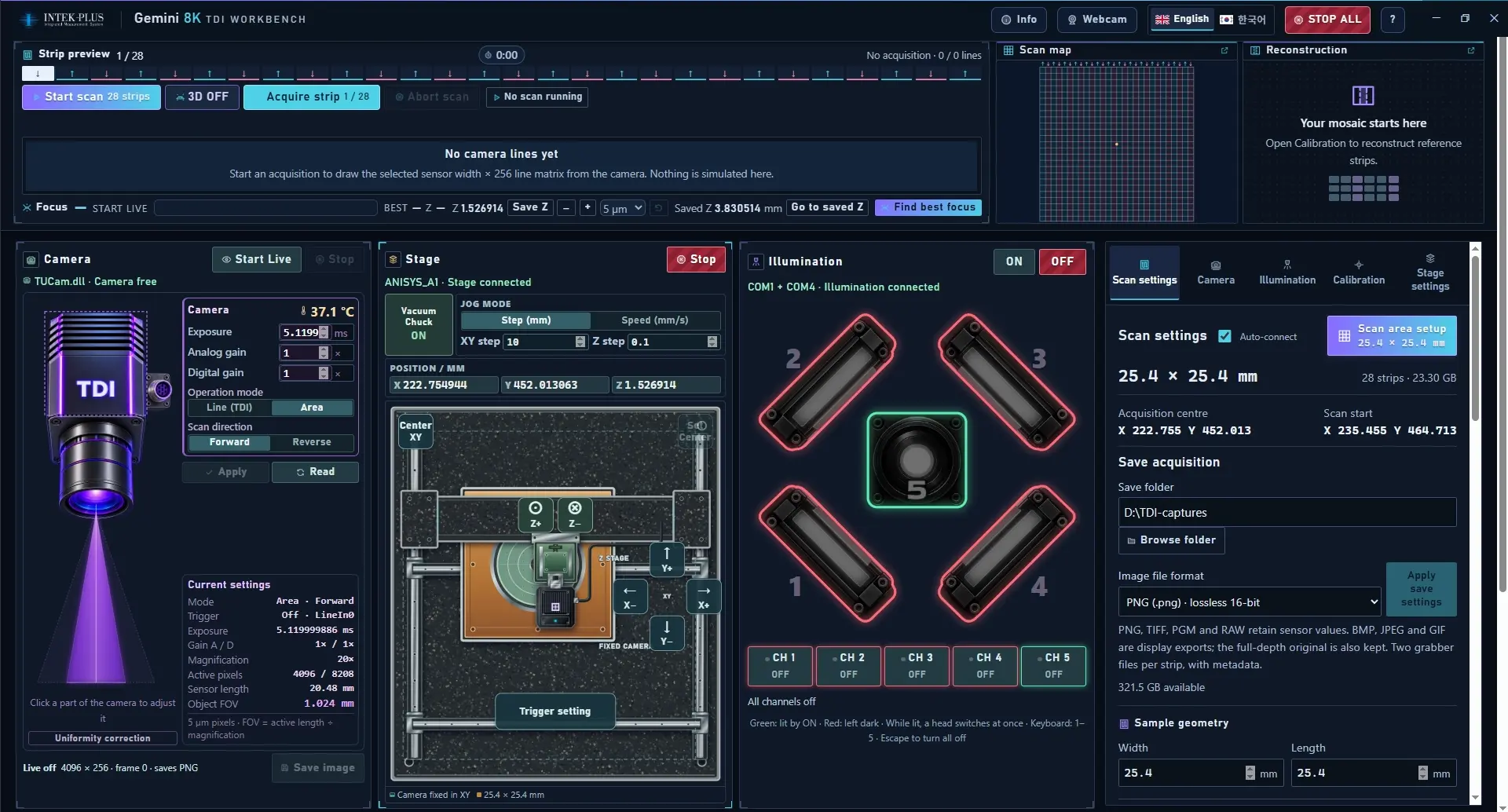
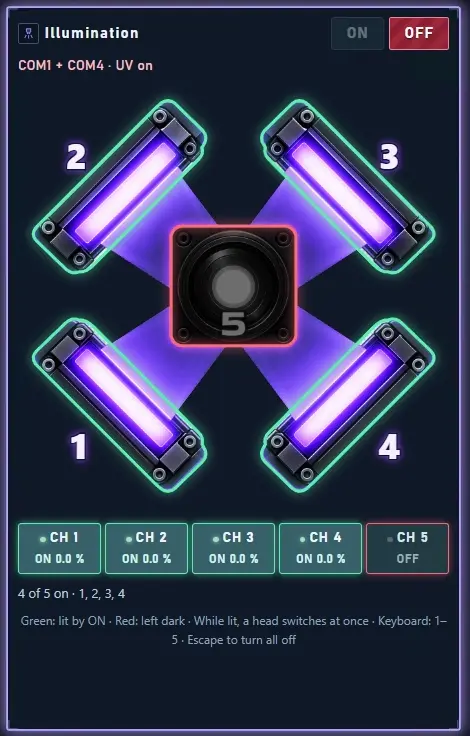
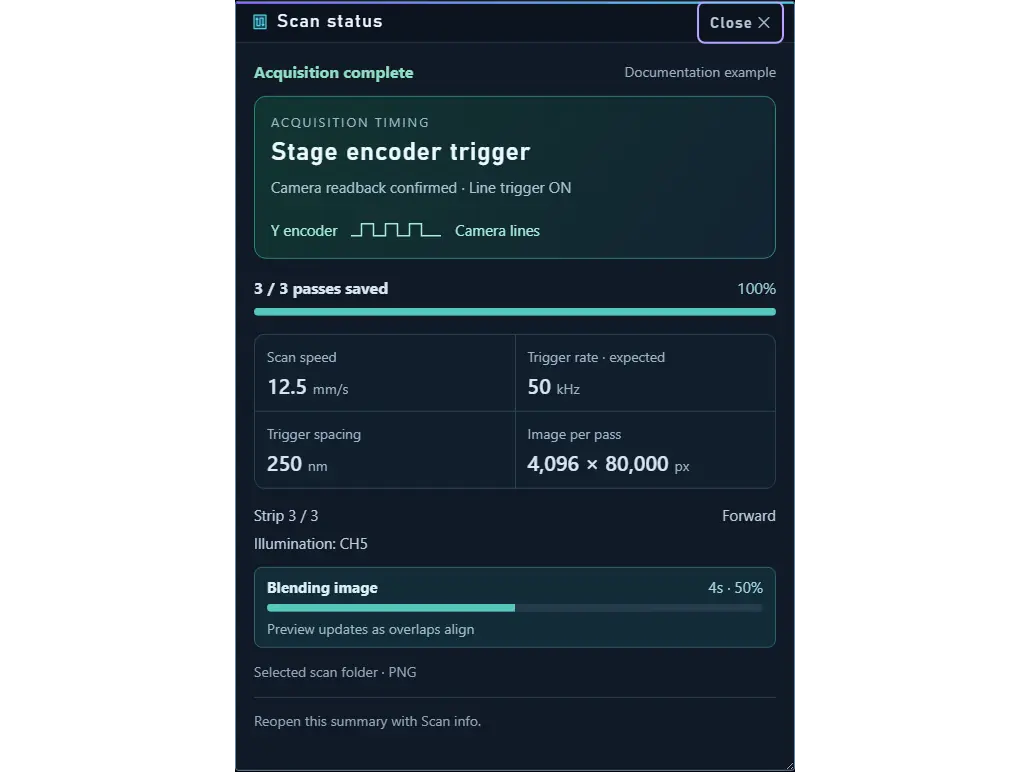
TDI Workbench runs a deep-UV line-scan station built on more than USD 300K of specialised hardware: a Tucsen Gemini 8K TDI camera imaging at 265 nm, two Coaxlink QSFP28 frame grabbers, a super-resolution Automation1 XYZ stage with 1 nm encoder resolution, and five 265 nm UV channels (four directional, one coaxial). Every device is controlled from one interactive GUI. The scan area, field of view (1K–8K sensor width), magnification, overlap and sampling are all selectable. Example: a 20 × 20 mm area at 250 nm sampling (42 strips) was acquired in 3 min 41 s and stitched into a single image about 3 minutes later.
End User: Intekplus
Duration: 2026/09 - 2026/10
Duration
2026/09 - 2026/10
Key Challenges
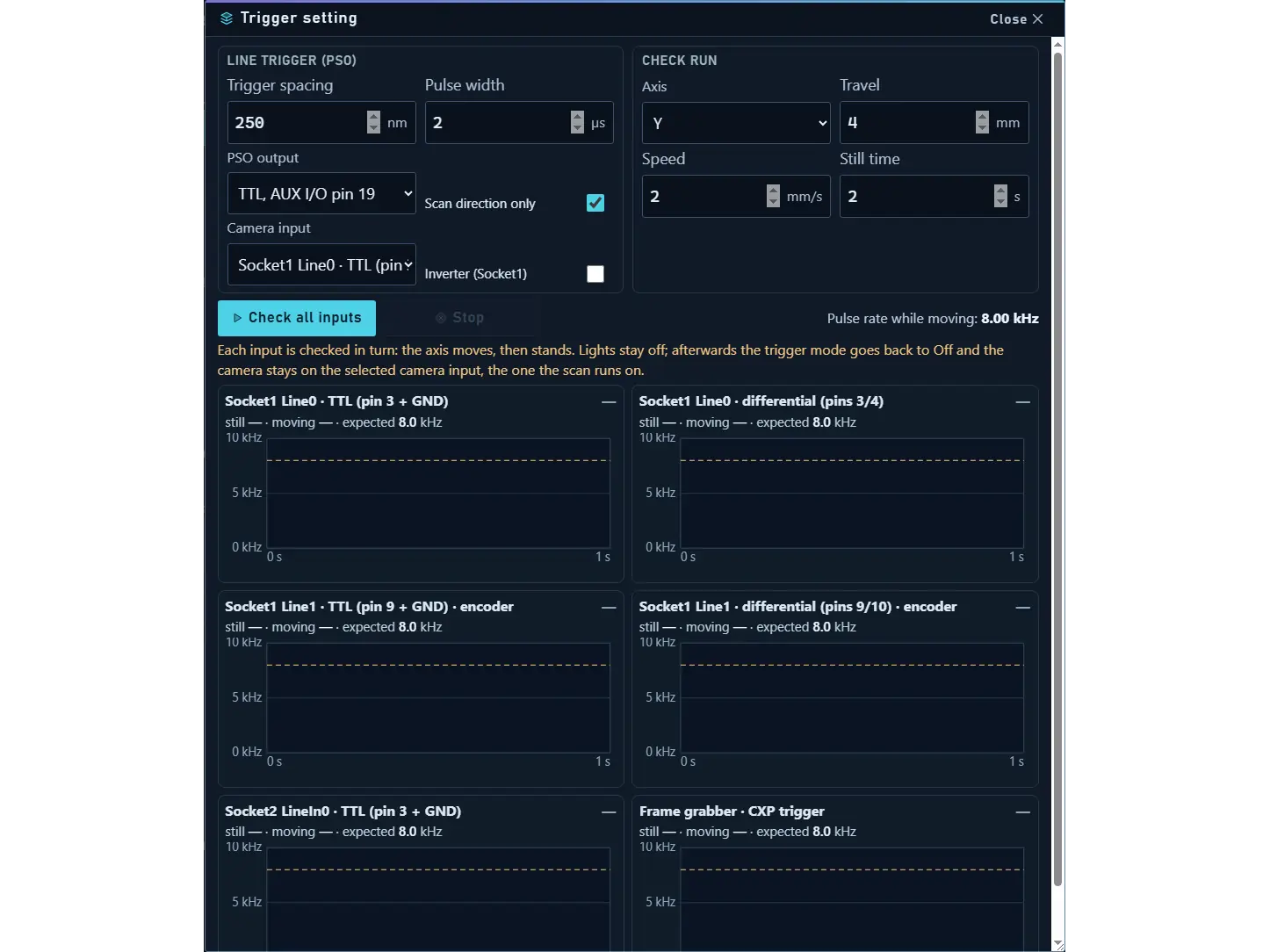
- Nanometric synchronisation: each camera line must be taken at an exact stage position, e.g. one line every 250 nm at 50 kHz. On camera timing, strips drifted by thousands of lines.
- Data rate: an 8,208-pixel line at up to 1 MHz produces 6–8 GB/s, far more than the PC can store (425 MB/s measured).
- Serpentine scanning: TDI direction and image orientation flip on every pass. A wrong direction smears the image; a wrong flip mirrors the strip.
- 3D from shadows: height has to be recovered from four directional UV images, and cast shadows and reflective areas corrupt the measured slopes.
Solutions
- Hardware trigger (PSO) from the 1 nm stage encoder, verified by camera readback at every scan start, plus a built-in test of every trigger input.
- Streaming pipeline with fixed-size buffers; sensor width, sampling and line rate are chosen against the measured storage throughput.
- TDI direction set per pass, and every strip registered on its measured overlap, with a warning when a seam cannot be matched.
- Shape-from-shadows: surface normals per pixel from the four heads with shadowed heads excluded, Frankot–Chellappa integration, and height calibrated on a step measured by focus.
Results & Impact
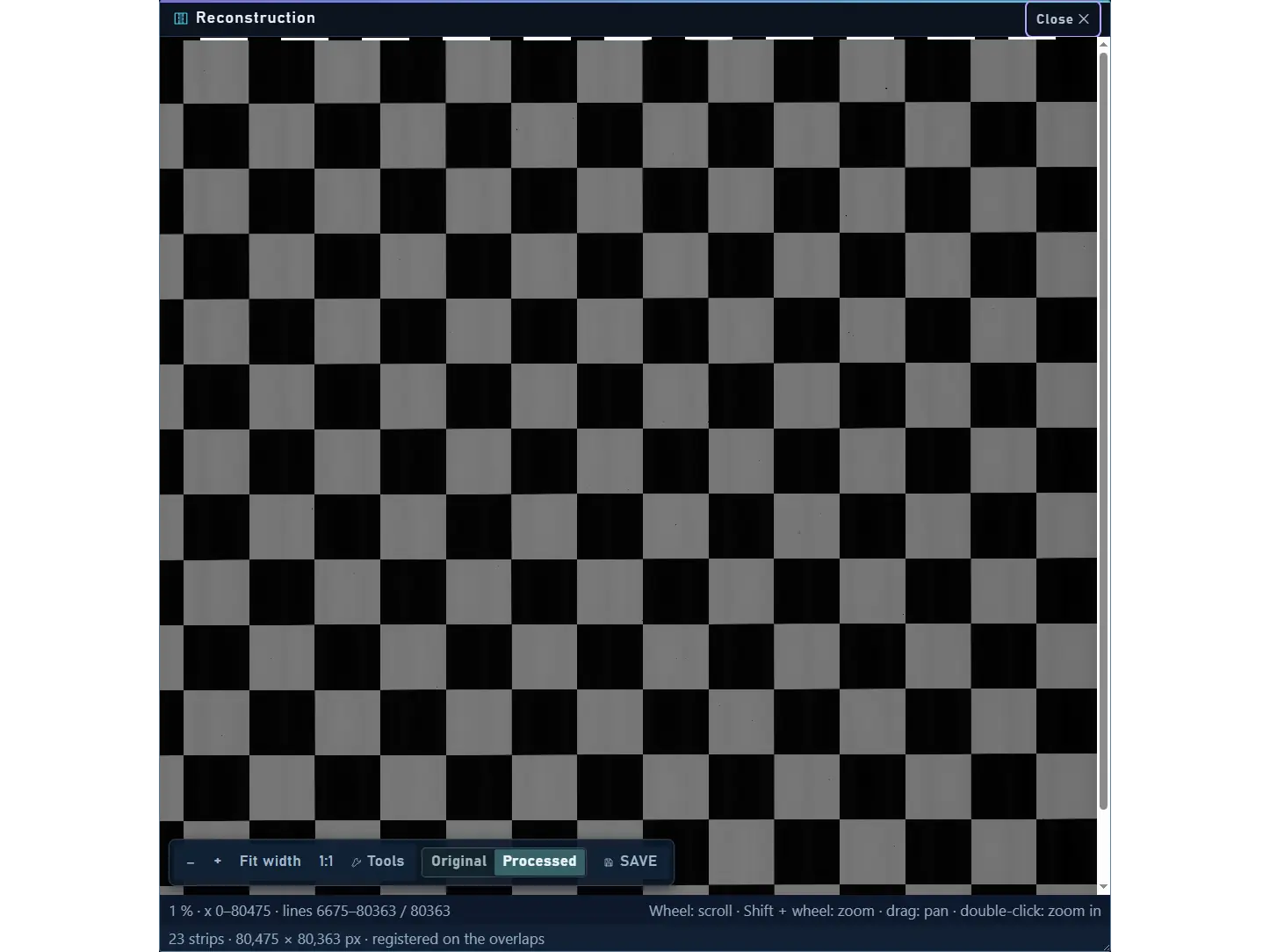
- 20 × 20 mm at 250 nm sampling acquired in 3 min 41 s; a 23-strip scan stitched into an 80,475 × 80,363 px (6.5 gigapixel) image.
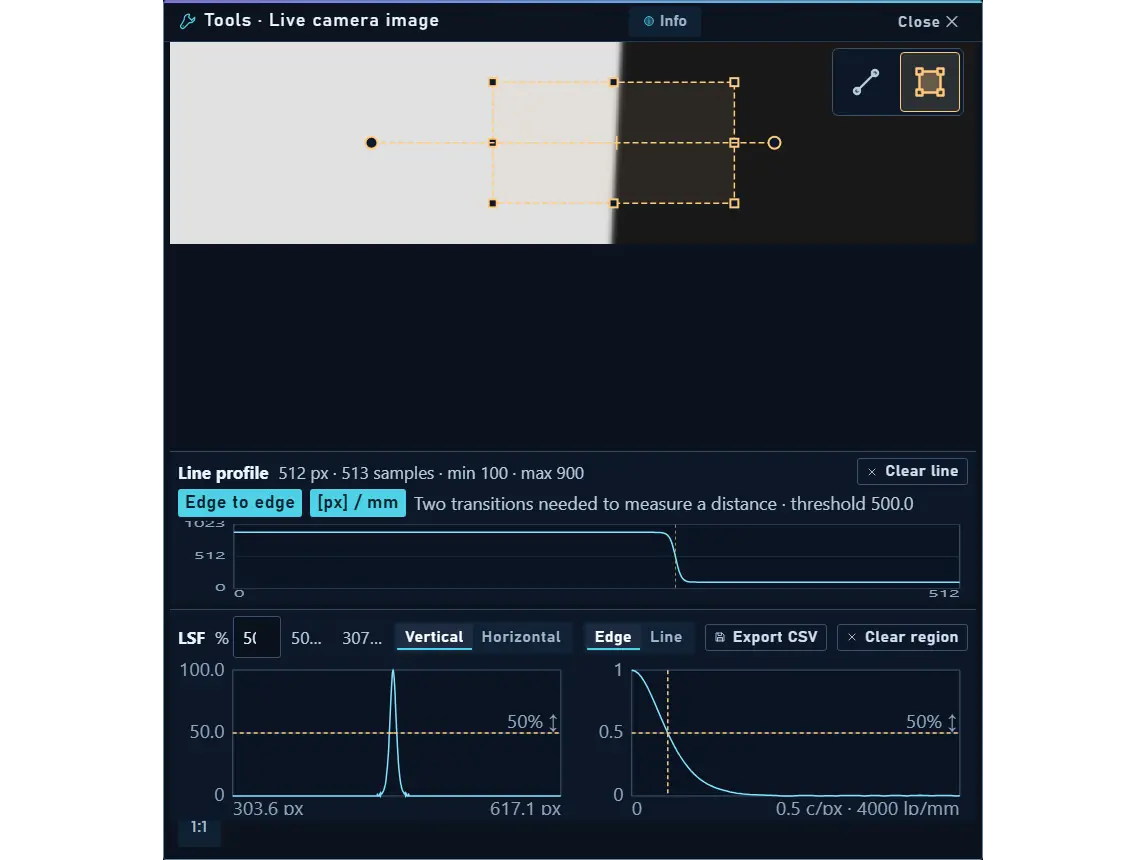
- Camera, grabbers, stage and lights run from one GUI, with lens-distortion, flat-field and DSNU/PRNU calibration and LSF/MTF measurement built in.
- English/Korean interface and a 43-page operator manual.